Medical Risk Profile and Analysis: Health Risk of Full Day Participation
Patient Profile: Male, Age 54
Primary Diagnosis: Stroke Survivor Type 2 Diabetes Mellitus (Unspecified Duration)
Additional Diagnoses: High Blood Pressure (Hypertension) and Heart Disease
Relevant History:
Ischemic Stroke (ISO Stroke): February 2023.
Wallerian Degeneration: Approximately six months post-stroke (August 2023).
Disability Status: Permanently Disabled (Verified by SSA).
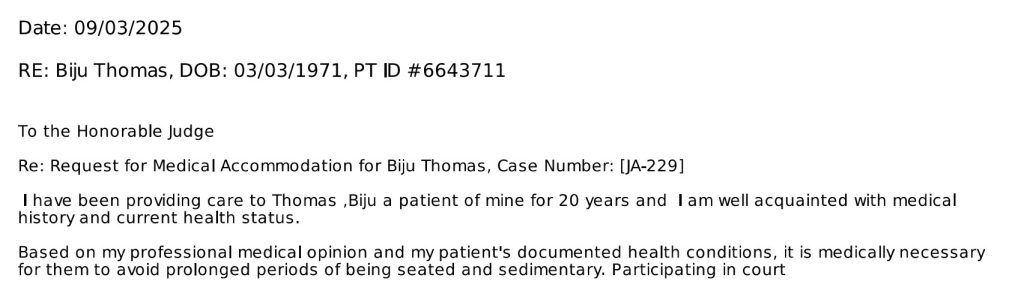
Standing Medical Orders: Must exercise, rest, sleep, or elevate feet every two (2) hours to prevent neuropathy, poor circulation, bleeding/swelling feet, and Post-Stroke Fatigue (PSF).
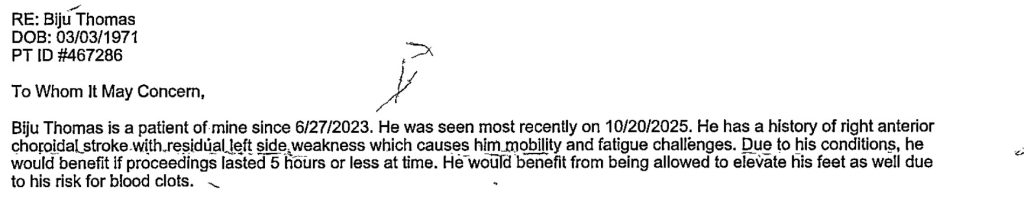
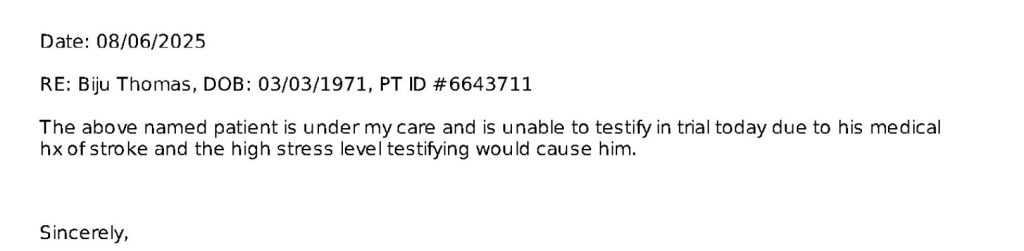
Doctors note: given to court conveying risks
Ordinary Sleep Schedule: Patient requires therapeutic naps every six (6) hours to maintain function.
1. Baseline Health Risk Summary
The patient presents as a highly vulnerable individual with established cardiovascular, neurological, and metabolic disease.
|
Risk Area
|
Status
|
Clinical Implication
|
|---|---|---|
|
Cardiovascular/Neurological
|
Severe Risk for Recurrence
|
History of Ischemic Stroke and Wallerian Degeneration, compounded by High Blood Pressure and Heart Disease, confirms extreme baseline vulnerability. Recurrent stroke, Transient Ischemic Attack (TIA), or cardiac event risk is significantly elevated.
|
|
Metabolic/Circulatory
|
Severe (Diabetes, Poor Circulation)
|
Diabetes is the primary driver of peripheral complications (neuropathy, edema). This significantly raises the risk of venous stasis, DVT, pressure ulcers, and infection.
|
|
Functional
|
Medically Fragile
|
SSA verification and strict standing orders confirm the inability to maintain standard activity levels without immediate, intervention-required relief every two hours.
|
2. Analysis of Harm Posed by 8 Hours of Forced Sitting (Worst Case: No Breaks)
8 hours of continuous, forced sitting severely violates the mandated bi-hourly medical interventions four times over, posing several acute and chronic risks to life and well-being.
Life-Threatening Thromboembolic Risk: Prolonged immobility creates venous stasis (sluggish blood flow) in the legs. In a patient with compromised circulation, this is highly likely to result in Deep Vein Thrombosis (DVT). If the clot travels to the lungs, it causes a life-threatening Pulmonary Embolism (PE).
Limb Preservation Risk: Diabetic neuropathy (lack of sensation) combined with poor circulation means continuous pressure on the feet and heels will cause rapid tissue ischemia and cellular necrosis. This leads to diabetic foot ulcers and pressure sores, which are the primary precursors to severe infection and potential amputation.
Stroke Recurrence/TIA: Lack of systemic movement and elevated stress increase the risk of an acute cardiovascular event, including recurrent Ischemic Stroke or TIA.
Acute Neurological/PSF Collapse Risk: Violation of the bi-hourly rest/sleep orders guarantees the onset of a severe Post-Stroke Fatigue (PSF) attack. This leads to acute mental collapse, stupor, loss of function, and prolonged bedridden recovery (historically confirmed as a week-long event), severely threatening neurological and psychological well-being.
3. Analysis of Risk with Proposed Accommodations
The risk is significantly mitigated by the allowance of breaks, but residual risks remain based on the nature of the elevation provided.
|
Accommodation
|
Effect on Standing Orders
|
Risk Mitigation/Impact
|
|---|---|---|
|
Guaranteed Walk Breaks (Every 2 Hours)
|
Directly satisfies the “exercise” requirement.
|
High Mitigation. This is the most crucial intervention. Walking activates the muscle pump, preventing severe venous stasis and dramatically reducing the risk of DVT and PE. This is essential for cardiovascular safety.
|
|
Water Breaks
|
General supportive care.
|
Minimal Mitigation. Helps maintain hydration but does not mechanically address the circulatory or pressure risks associated with immobility.
|
|
Seated Elevation (Waist Level)
|
Minimally satisfies the “elevate feet” requirement.
|
Low Mitigation. For therapeutic venous return (to reduce swelling/DVT risk), the feet must typically be elevated above the level of the heart. Elevation only to “waist level” while seated provides minimal benefit against gravity, meaning the risks of swelling (edema) and localized pressure-induced tissue damage remain significantly high.
|
Conclusion on Accommodations and Systemic Stress: While guaranteed walk breaks every two hours (which must be confirmed) provide critical protection against DVT/PE and stroke, the prolonged cognitive and emotional stress, compounded by inadequate elevation, guarantees the acute onset of a severe Post-Stroke Fatigue (PSF) collapse. The risks of severe edema/tissue damage and systemic collapse remain significantly high. Past incidents prove that this level of exposure triggers a week-long period of incapacitation. Strict adherence to the 2-hour intervention window (including effective rest/sleep/elevation) is non-negotiable for safety and PSF prevention.
4. Pattern of Acute Collapse (August 6th and September 8th, 2025)
The patient has a proven, highly sensitive response to prolonged stress and immobility that violates the -hour intervention orders and the -hour nap cycle.
Precedent Incident: August 6, 2025
Result: Limits were reached previously at the Aug 6th hearing where proceedings were ended one hour earlier than planned.
Recovery: The patient was bedridden the entire next day and experienced severe fatigue for an entire week afterward. This established the functional collapse pattern of Post-Stroke Fatigue (PSF) and the inadequacy of prolonged exposure.
Acute Collapse Incident: September 8, 2025
Timeline: The collapse occurred following a cumulative period of sustained stress and immobility totaling approximately 8.5 hours ( hour driving + hours courtroom attendance, with only a -lunch break).
Critical Metabolic Data: Blood sugar was elevating despite not eating (Hyperglycemia) during the court hearing and was confirmed high an hour later.
Symptom Sequence (Onset Resolution):
Fatigue/Trouble Remaining Awake (Initial symptom).
Slurred Speech Unable to Speak (Acute neurological deficit).
Confused, Foggy Memory (Acute cognitive deficit).
Pulled over, Passed Out (Loss of Consciousness)
Clouded Memory of Final Events (Residual amnesia).
Recovery/Sequelae: Patient was bedridden for almost a week and remains acutely fatigued. Currently experiencing cognitive and memory decline, headaches, dizziness, and vertigo.
Scheduled Follow-Up: The severity of the sequelae has necessitated a Full Brain MRI scheduled October 14th and a Neurologist Follow-up scheduled October 20th to assess for new, permanent structural brain damage.
Potential Medical Event(s) Based on Description
|
Event
|
Plausibility
|
Reasoning based on Symptoms and Metabolic Data
|
|---|---|---|
|
A. Metabolic Crisis / Hyperglycemia
|
Highest.
|
The elevated blood sugar () due to stress and poor nutritional intake triggered symptoms that perfectly mimic a stroke (slurred speech, confusion) and induced profound fatigue and prolonged loss of consciousness (stupor).
|
|
B. TIA-Triggered Cascade (PSF/Syncope)
|
High.
|
A brief TIA event (explaining acute slurred speech) acted as a stressor, triggering a catastrophic PSF attack (Section 5) and potential Vasovagal Syncope (fainting), leading to the minute unresponsiveness.
|
|
C. Recurrent Ischemic Stroke
|
Cannot Be Ruled Out.
|
The sustained neurological and cognitive deficits (slurred speech, memory decline, vertigo) following the collapse, along with the scheduled MRI, indicate a serious possibility of a new, minor stroke event (Silent Stroke) that caused permanent damage.
|
Summary: The September 8th incident was a life-threatening collapse resulting from a combined Metabolic and Cerebrovascular Crisis. The immediate and lasting severe symptoms confirm that forced, prolonged immobility poses a direct, demonstrable danger to the patient’s neurological and cardiovascular health.
5. Explanation of PSF (Post-Stroke Fatigue) and Sleep Schedule
Definition:
Post-Stroke Fatigue (PSF) is a common, debilitating, and persistent symptom experienced by up to 70% of stroke survivors. It is a profound feeling of exhaustion that is disproportionate to the activity performed, is not relieved by rest, and significantly interferes with daily functioning.
Ordinary Sleep Schedule: The patient’s ordinary schedule involves taking therapeutic naps every six (6) hours. This schedule emphasizes the necessity for planned, mandated rest to maintain baseline functionality.
Clinical Relevance to the Incidents:
Load Failure and Prolonged Recovery: The catastrophic outcomes of the August 6th and September 8th incidents (including being bedridden for almost a week) provide irrefutable empirical evidence of the catastrophic, life-altering outcome of an acute PSF attack triggered by the forced violation of standing medical orders.
6. Transient Ischemic Attack (TIA) Risk and Analysis
|
Feature
|
Description
|
|---|---|
|
Risk in This Patient
|
Extremely High. TIA is a warning sign that often precedes a major stroke. With a history of Ischemic Stroke, Wallerian Degeneration, Heart Disease, and Hypertension, the patient is in the highest risk category for TIA or recurrent stroke.
|
|
Definition
|
A brief episode of neurological dysfunction caused by focal brain or retinal ischemia, with clinical symptoms typically lasting less than one hour, and without evidence of acute infarction (cell death) on brain imaging. It is often referred to as a “mini-stroke.”
|
|
Common Symptoms
|
Symptoms are identical to a full stroke but temporary (often following the FAST acronym): Face drooping, Arm weakness, Speech difficulty (slurred or confused), Time to call emergency services. Other symptoms include temporary vision loss in one eye or profound dizziness/loss of balance.
|
|
Detectability (During/After)
|
During: Symptoms resolve quickly, making in-the-moment diagnosis difficult. After: Diagnosis is based primarily on clinical history. Brain imaging (MRI/CT) performed after the event usually shows no evidence of permanent damage (infarction), which is the differentiating factor from a completed stroke.
|
|
Potential Consequences
|
A TIA is a medical emergency and a powerful predictor of a full, major stroke. Untreated TIA carries a high risk of leading to permanent disability, severe long-term cognitive impairment, or death within days or hours of the initial event.
|
7. Symptomatic Hyperglycemia / Metabolic Crisis Analysis
|
Feature
|
Description
|
|---|---|
|
Risk in This Patient
|
Extremely High. Patient is diabetic, skipping meals, and under extreme stress, all of which cause blood sugar to rise unpredictably.
|
|
Definition
|
A medical emergency caused by dangerously high blood glucose levels (Hyperglycemia), resulting in systemic dehydration, organ stress, and the accumulation of toxic byproducts. This can lead to Diabetic Ketoacidosis (DKA) or Hyperosmolar Hyperglycemic State (HHS).
|
|
Common Symptoms
|
Extreme thirst, frequent urination, profound fatigue/lethargy, blurred vision, neurological symptoms (confusion, slurred speech, stupor, loss of consciousness), and severe headache. Dehydration exacerbates these symptoms, including dizziness and fainting risk.
|
|
Detectability (During/After)
|
During: Confirmed with a blood glucose meter reading. After: The neurological symptoms resolve upon correction of blood sugar, but the event itself can cause massive systemic stress, triggering conditions like TIA and severe PSF collapse.
|
|
Potential Consequences
|
Untreated, severe hyperglycemia (DKA/HHS) is immediately life-threatening. It can lead to Diabetic Coma, permanent brain damage, kidney failure, or death. Even resolved episodes cause massive systemic shock, triggering acute Post-Stroke Fatigue (PSF) and cardiovascular events.
|
8. Myocardial Infarction (Heart Attack) Risk
|
Feature
|
Description
|
|---|---|
|
Risk in This Patient
|
Severely Elevated. The patient has a trifecta of primary risk factors: Heart Disease, High Blood Pressure, and Diabetes. These conditions compromise the coronary arteries that supply the heart muscle.
|
|
Definition
|
A heart attack (MI) occurs when blood flow to a section of heart muscle is blocked, usually by a blood clot. If blood flow is not restored quickly, the heart muscle begins to die.
|
|
Contributing Factors
|
The combination of existing Heart Disease and the intense physical and emotional stress of the -hour exposure, compounded by the Metabolic Crisis, places a severe acute load on the heart. This stress can trigger a cardiac event.
|
|
Potential Consequences
|
A heart attack is immediately life-threatening. Consequences include sudden cardiac arrest, permanent damage to the heart muscle (heart failure), or death. The stress of a near-MI event also directly increases the risk of a recurrent stroke.
|